Weekly · beginners welcome · no partner required
Ballroom Dance Classes in Blackpool
Ballroom dance classes in Blackpool, in the one town in Britain where ballroom is not a niche interest. Every spring the best in the world arrive here to compete; the rest of the year this is an ordinary weekly hour in a town-centre studio, where beginners learn the waltz from the first step, partners rotate and nobody has to bring anyone. A class costs a tenner; four weeks in a row comes to thirty-two pounds.
Getting started
One message and the ballroom evening comes back.
Ballroom lands on the same weeknight each week, in a studio a short walk back from the Promenade. We email the evening and the address instead of printing them, so nothing on this page can go out of date, and we put a line about shoes in with the reply.
- Ten pounds for a class, thirty-two for four in a row
- Turn up alone — the room swaps partners all hour
- Waltz first, then quickstep and foxtrot as the block goes on
The essentials
- Where Blackpool town centre studio
- When Weekly, evening — sent by reply
- Length One hour
- Level Beginners upward
- Ages 17 – 75
- Partner Not needed · partners rotate
The class
The town's own dance.
Ballroom where the standard gets set
Nowhere in Britain has a stronger claim on ballroom than Blackpool. Once a year the town fills with dancers from every continent, judges fly in, and the seafront hotels are full of people carrying dress bags — and then it all leaves, and the rest of us go back to learning the waltz on a weeknight. That is what this class is: not a competition pipeline, just the social version of the same dances, taught from nothing, on our weekly Blackpool timetable.
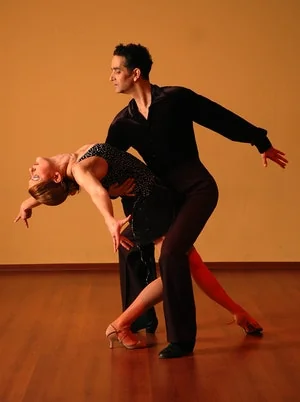
Beginners start with the waltz, because its rise and fall makes the shape of ballroom obvious, and because a box step can be learnt in ten minutes and improved for ten years. Quickstep and social foxtrot follow. The hold is taught properly — where the arms go, who is steering, and how two people move as one thing without either of them shoving — and partners change every few tracks, which is exactly why the ones who arrive on their own get on quickest. The room is a spread: retired couples in from Cleveleys and Poulton, people in their twenties who watched far too much of it on prime-time telly, and a steady flow from Lytham and Preston. There is nothing formal about the dress either — most people arrive in whatever they came from work in, and the only real requirement is a shoe that will let a foot turn.
What the hour holds
It opens with footwork on your own, so the timing settles before anyone has to think about a partner. Then hold, then the figure of the week, then the lot joined up to music. Across a four-week block a short routine builds that you could use at a function without rehearsing it first. A good few dancers here pick up tango alongside it for the contrast, and couples with a date in the diary tend to take the waltz straight into their first dance. Nothing gets choreographed for a competition floor; the figures taught here are the ones that fit a crowded function room.
Four weeks in hold
Box step to something you would dance in public.
This is the normal shape of four weeks, though the pace belongs to whoever is in the room.
The waltz box
Six steps in a square, rise and fall, and the count everything else hangs off. Solo first, then in hold.
Travelling
The box opens out and starts moving down the floor, which is where the line of dance and a bit of etiquette come in.
Turning
Natural and reverse turns, so a couple can get round a corner without a collision or an argument.
A second dance
Quickstep or social foxtrot laid on top, plus the whole waltz sequence run to music at proper tempo.
Side effects
What ballroom hands over.
You come for the waltz. This lot follows.
- A dance you can use at any wedding, function or works do
- Posture that survives the walk back to the car
- Leading or following without either turning into an argument
- Low-impact exercise that keeps going for a full hour
- Sharper listening — you start hearing the beat in everything
- A weeknight crowd that carries on right through the winter
- Balance and footwork that make every other style easier
- The nerve to get up first while the floor is still empty
Straight answers
Ballroom in Blackpool, the usual questions.
Ten things people ask before booking a first ballroom dance class in Blackpool.
ICan I learn ballroom without bringing a partner?
No. Partners rotate through the hour, so a single dancer gets more time in hold than someone glued to one person. Couples who prefer to stay together can, provided they are happy to swap now and again.
IIWhich dances will I learn?
Waltz to start with, then quickstep and social foxtrot, with a cha-cha or a jive turning up when a room fancies it. These are the social versions — the ones that work on an ordinary floor rather than the ones being marked by judges.
IIIIs this the competitive sort of ballroom?
No, and that is deliberate. Blackpool has plenty of places to take ballroom extremely seriously; this class is for people who want to dance at weddings and functions without treading on anyone. Anyone who catches the bug and wants more, we will point in the right direction.
IVWhich shoes and clothes suit a first ballroom class?
Something you can move in, with a shoe that turns: a smooth sole, a modest heel you are steady in, or ballroom shoes if you have inherited a pair. Trainers with a lot of grip fight every pivot. We do not supply shoes or any other kit, so bring your own.
VHow soon could I dance at a wedding?
A block of four normally covers a waltz you could get through in public without counting out loud. Add a second block and you will have a couple of dances and enough nerve to start one. It is a shorter road than people assume.
VIHow much are the classes?
£10 for a single class, handed over on the night, or £32 for four weeks in a row, which is £8 each. No membership, no joining fee and nothing coming out of your bank.
VIIWhere's the ballroom class held?
Blackpool town centre. Parking sits within a few minutes' walk and the tram drops you close by. We hand the address over when we send your timetable, because the schedule decides which room the class ends up in.
VIIIIs there an age limit?
The weekly class is written for 17 to 75, and in practice the room usually spans most of that. Ballroom is unusually kind to a wide age range, being technical rather than athletic, and everything runs at a pace people can hold.
IXCan two women or two men dance together?
Of course. Lead and follow are jobs rather than genders, and a fair few people here learn both. Whoever you walk in with, the rotation will pair you with everybody sooner or later.
XCan I come to just one class first?
Yes. The ten-pound drop-in is there so you can look at the room, hear the teaching and decide afterwards. A block starts the following week if you want one, and nothing at all happens if you do not.